Hex viewer
Klennet Recovery features a built-in hex viewer.
The same hex viewer works for disks and file previews.
It is, however, rather basic.
Consider a dedicated tool like WinHex if you want something with more features.
To open a hex view of a disk, partition, or RAID,
checkmark what you want to view in the Physical Disks tab
or in the RAIDs tab, and click the Hex View button on the toolbar.
To open a hex view of a recovered file, select the file in the
Filesystem tab and use the Hex View button on the toolbar.
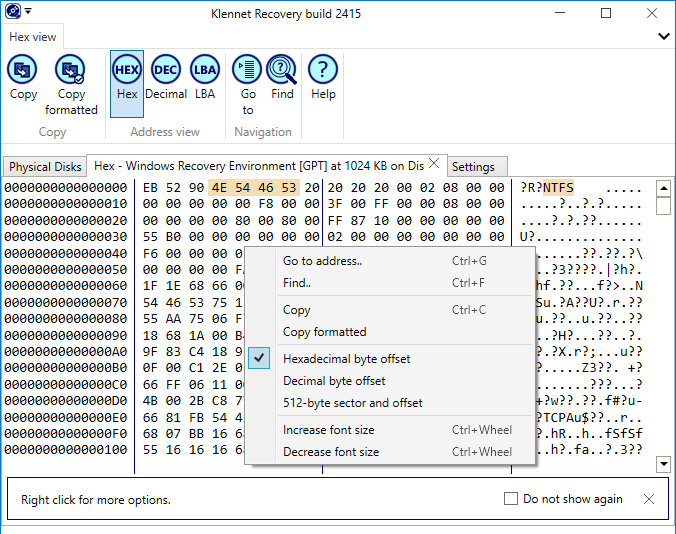 Hex viewer screenshot.
Navigation and address format
You can switch the address format from a toolbar. The allowed modes are:
- hexadecimal byte offset;
- decimal byte offset;
- decimal LBA (512-byte sector number), followed by hexadecimal byte offset within the sector.
You can move around using the arrow keys, PageUp, PageDown, Home, and End on the keyboard.
Also, you can go to the specific address (Ctrl+G).
Selection and copying
To select the data on one side, click and drag your mouse on that side.
To select both sides simultaneously, start dragging on one side and finish on the other.
If one side is selected, the hex bytes' text representation is copied, like 12 34 AB CD, or the ASCII text.
If both sides are selected, the viewer copies the ASCII-art formatted version of the data.
The Copy Formatted option always produces a side-by-side ASCII-art representation,
regardless of what side is selected.
Search
Use Ctrl+F or the toolbar button to open the search dialog. You can search for any of the following:
- Text string. Text search is case-sensitive. You can specify one or more encodings to use (ASCII, UTF8, or UTF16LE).
- Array of hexadecimal bytes. Allowed separators are space, period
., colon :, and dash -.
- Any nonzero data. This is useful if you need to skip a zero-filled section of a file or a disk.